 Add to Chrome
 Add to Firefox
 Add to Edge
Dexora: Open-source VLA for High-DoF Bimanual Dexterity
May 18, 2026
Vision-Language-Action (VLA) models have recently become a central direction in embodied AI, but current systems are restricted to either dual-gripper control or single-arm dexterous hand manipulation. While low-dimensional gripper control can often be handled with simpler methods, high-dimensional dexterous hand control benefits greatly from full end-to-end VLA learning. In this work, we introduce Dexora, the first open-source VLA system that natively targets dual-arm, dual-hand high-DoF manipulation. We design a hybrid teleoperation pipeline that decouples gross arm kinematics (captured with a custom exoskeleton backpack) from fine finger motion (markerless hand tracking via Apple Vision Pro), and that drives both a physical dual-arm dual-hand platform and an identical MuJoCo digital twin. Using that interface, we assemble a large training corpus: an embodiment-matched synthetic corpus (100K simulated trajectories, 6.5M frames) and a real-world dataset of 10K teleoperated episodes (2.92M frames). To mitigate noisy teleoperation demonstrations, we propose a data-quality-aware training recipe: an offline discriminator provides clip-level weights for diffusion-transformer policy training, down-weighting low-quality demonstrations. Empirically, Dexora outperforms competitive VLA baselines on both basic and dexterous benchmarks (e.g., average dexterous success 66.7% vs. 51.7%), attains 90% success on basic tasks, and shows robust out-of-distribution and cross-embodiment generalization. Ablations confirm the importance of real data and the discriminator for dexterity.

PAM: A Pose-Appearance-Motion Engine for Sim-to-Real HOI Video Generation
Mar 23, 2026Hand-object interaction (HOI) reconstruction and synthesis are becoming central to embodied AI and AR/VR. Yet, despite rapid progress, existing HOI generation research remains fragmented across three disjoint tracks: (1) pose-only synthesis that predicts MANO trajectories without producing pixels; (2) single-image HOI generation that hallucinates appearance from masks or 2D cues but lacks dynamics; and (3) video generation methods that require both the entire pose sequence and the ground-truth first frame as inputs, preventing true sim-to-real deployment. Inspired by the philosophy of Joo et al. (2018), we think that HOI generation requires a unified engine that brings together pose, appearance, and motion within one coherent framework. Thus we introduce PAM: a Pose-Appearance-Motion Engine for controllable HOI video generation. The performance of our engine is validated by: (1) On DexYCB, we obtain an FVD of 29.13 (vs. 38.83 for InterDyn), and MPJPE of 19.37 mm (vs. 30.05 mm for CosHand), while generating higher-resolution 480x720 videos compared to 256x256 and 256x384 baselines. (2) On OAKINK2, our full multi-condition model improves FVD from 68.76 to 46.31. (3) An ablation over input conditions on DexYCB shows that combining depth, segmentation, and keypoints consistently yields the best results. (4) For a downstream hand pose estimation task using SimpleHand, augmenting training with 3,400 synthetic videos (207k frames) allows a model trained on only 50% of the real data plus our synthetic data to match the 100% real baseline.
Learning Athletic Humanoid Tennis Skills from Imperfect Human Motion Data
Mar 13, 2026Human athletes demonstrate versatile and highly-dynamic tennis skills to successfully conduct competitive rallies with a high-speed tennis ball. However, reproducing such behaviors on humanoid robots is difficult, partially due to the lack of perfect humanoid action data or human kinematic motion data in tennis scenarios as reference. In this work, we propose LATENT, a system that Learns Athletic humanoid TEnnis skills from imperfect human motioN daTa. The imperfect human motion data consist only of motion fragments that capture the primitive skills used when playing tennis rather than precise and complete human-tennis motion sequences from real-world tennis matches, thereby significantly reducing the difficulty of data collection. Our key insight is that, despite being imperfect, such quasi-realistic data still provide priors about human primitive skills in tennis scenarios. With further correction and composition, we learn a humanoid policy that can consistently strike incoming balls under a wide range of conditions and return them to target locations, while preserving natural motion styles. We also propose a series of designs for robust sim-to-real transfer and deploy our policy on the Unitree G1 humanoid robot. Our method achieves surprising results in the real world and can stably sustain multi-shot rallies with human players. Project page: https://zzk273.github.io/LATENT/
LDA-1B: Scaling Latent Dynamics Action Model via Universal Embodied Data Ingestion
Feb 12, 2026Recent robot foundation models largely rely on large-scale behavior cloning, which imitates expert actions but discards transferable dynamics knowledge embedded in heterogeneous embodied data. While the Unified World Model (UWM) formulation has the potential to leverage such diverse data, existing instantiations struggle to scale to foundation-level due to coarse data usage and fragmented datasets. We introduce LDA-1B, a robot foundation model that scales through universal embodied data ingestion by jointly learning dynamics, policy, and visual forecasting, assigning distinct roles to data of varying quality. To support this regime at scale, we assemble and standardize EI-30k, an embodied interaction dataset comprising over 30k hours of human and robot trajectories in a unified format. Scalable dynamics learning over such heterogeneous data is enabled by prediction in a structured DINO latent space, which avoids redundant pixel-space appearance modeling. Complementing this representation, LDA-1B employs a multi-modal diffusion transformer to handle asynchronous vision and action streams, enabling stable training at the 1B-parameter scale. Experiments in simulation and the real world show LDA-1B outperforms prior methods (e.g., $π_{0.5}$) by up to 21\%, 48\%, and 23\% on contact-rich, dexterous, and long-horizon tasks, respectively. Notably, LDA-1B enables data-efficient fine-tuning, gaining 10\% by leveraging 30\% low-quality trajectories typically harmful and discarded.
RF-MatID: Dataset and Benchmark for Radio Frequency Material Identification
Jan 28, 2026Accurate material identification plays a crucial role in embodied AI systems, enabling a wide range of applications. However, current vision-based solutions are limited by the inherent constraints of optical sensors, while radio-frequency (RF) approaches, which can reveal intrinsic material properties, have received growing attention. Despite this progress, RF-based material identification remains hindered by the lack of large-scale public datasets and the limited benchmarking of learning-based approaches. In this work, we present RF-MatID, the first open-source, large-scale, wide-band, and geometry-diverse RF dataset for fine-grained material identification. RF-MatID includes 16 fine-grained categories grouped into 5 superclasses, spanning a broad frequency range from 4 to 43.5 GHz, and comprises 142k samples in both frequency- and time-domain representations. The dataset systematically incorporates controlled geometry perturbations, including variations in incidence angle and stand-off distance. We further establish a multi-setting, multi-protocol benchmark by evaluating state-of-the-art deep learning models, assessing both in-distribution performance and out-of-distribution robustness under cross-angle and cross-distance shifts. The 5 frequency-allocation protocols enable systematic frequency- and region-level analysis, thereby facilitating real-world deployment. RF-MatID aims to enable reproducible research, accelerate algorithmic advancement, foster cross-domain robustness, and support the development of real-world application in RF-based material identification.
Collision-Free Humanoid Traversal in Cluttered Indoor Scenes
Jan 23, 2026We study the problem of collision-free humanoid traversal in cluttered indoor scenes, such as hurdling over objects scattered on the floor, crouching under low-hanging obstacles, or squeezing through narrow passages. To achieve this goal, the humanoid needs to map its perception of surrounding obstacles with diverse spatial layouts and geometries to the corresponding traversal skills. However, the lack of an effective representation that captures humanoid-obstacle relationships during collision avoidance makes directly learning such mappings difficult. We therefore propose Humanoid Potential Field (HumanoidPF), which encodes these relationships as collision-free motion directions, significantly facilitating RL-based traversal skill learning. We also find that HumanoidPF exhibits a surprisingly negligible sim-to-real gap as a perceptual representation. To further enable generalizable traversal skills through diverse and challenging cluttered indoor scenes, we further propose a hybrid scene generation method, incorporating crops of realistic 3D indoor scenes and procedurally synthesized obstacles. We successfully transfer our policy to the real world and develop a teleoperation system where users could command the humanoid to traverse in cluttered indoor scenes with just a single click. Extensive experiments are conducted in both simulation and the real world to validate the effectiveness of our method. Demos and code can be found in our website: https://axian12138.github.io/CAT/.
Track Any Motions under Any Disturbances
Sep 17, 2025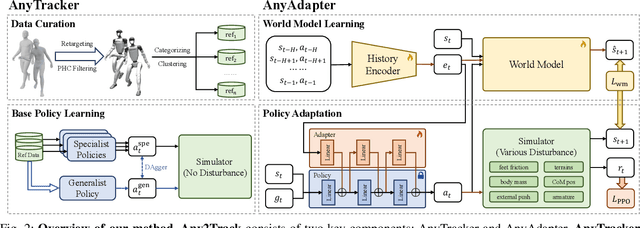

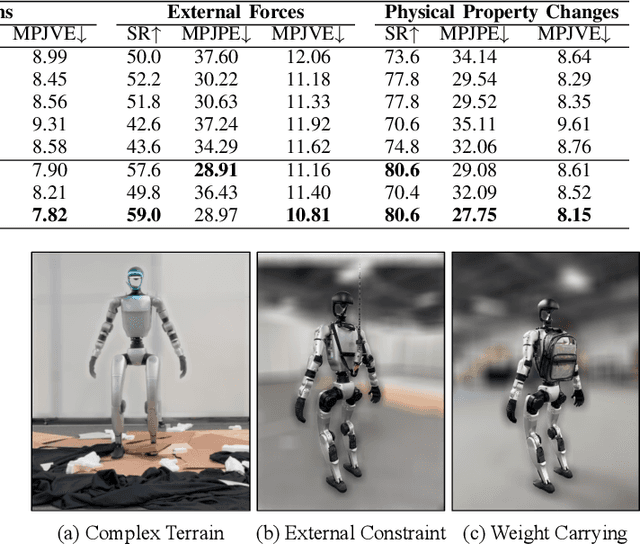

A foundational humanoid motion tracker is expected to be able to track diverse, highly dynamic, and contact-rich motions. More importantly, it needs to operate stably in real-world scenarios against various dynamics disturbances, including terrains, external forces, and physical property changes for general practical use. To achieve this goal, we propose Any2Track (Track Any motions under Any disturbances), a two-stage RL framework to track various motions under multiple disturbances in the real world. Any2Track reformulates dynamics adaptability as an additional capability on top of basic action execution and consists of two key components: AnyTracker and AnyAdapter. AnyTracker is a general motion tracker with a series of careful designs to track various motions within a single policy. AnyAdapter is a history-informed adaptation module that endows the tracker with online dynamics adaptability to overcome the sim2real gap and multiple real-world disturbances. We deploy Any2Track on Unitree G1 hardware and achieve a successful sim2real transfer in a zero-shot manner. Any2Track performs exceptionally well in tracking various motions under multiple real-world disturbances.
DexVLG: Dexterous Vision-Language-Grasp Model at Scale
Jul 03, 2025As large models gain traction, vision-language-action (VLA) systems are enabling robots to tackle increasingly complex tasks. However, limited by the difficulty of data collection, progress has mainly focused on controlling simple gripper end-effectors. There is little research on functional grasping with large models for human-like dexterous hands. In this paper, we introduce DexVLG, a large Vision-Language-Grasp model for Dexterous grasp pose prediction aligned with language instructions using single-view RGBD input. To accomplish this, we generate a dataset of 170 million dexterous grasp poses mapped to semantic parts across 174,000 objects in simulation, paired with detailed part-level captions. This large-scale dataset, named DexGraspNet 3.0, is used to train a VLM and flow-matching-based pose head capable of producing instruction-aligned grasp poses for tabletop objects. To assess DexVLG's performance, we create benchmarks in physics-based simulations and conduct real-world experiments. Extensive testing demonstrates DexVLG's strong zero-shot generalization capabilities-achieving over 76% zero-shot execution success rate and state-of-the-art part-grasp accuracy in simulation-and successful part-aligned grasps on physical objects in real-world scenarios.
Unleashing Humanoid Reaching Potential via Real-world-Ready Skill Space
May 16, 2025Humans possess a large reachable space in the 3D world, enabling interaction with objects at varying heights and distances. However, realizing such large-space reaching on humanoids is a complex whole-body control problem and requires the robot to master diverse skills simultaneously-including base positioning and reorientation, height and body posture adjustments, and end-effector pose control. Learning from scratch often leads to optimization difficulty and poor sim2real transferability. To address this challenge, we propose Real-world-Ready Skill Space (R2S2). Our approach begins with a carefully designed skill library consisting of real-world-ready primitive skills. We ensure optimal performance and robust sim2real transfer through individual skill tuning and sim2real evaluation. These skills are then ensembled into a unified latent space, serving as a structured prior that helps task execution in an efficient and sim2real transferable manner. A high-level planner, trained to sample skills from this space, enables the robot to accomplish real-world goal-reaching tasks. We demonstrate zero-shot sim2real transfer and validate R2S2 in multiple challenging goal-reaching scenarios.
FB-4D: Spatial-Temporal Coherent Dynamic 3D Content Generation with Feature Banks
Mar 26, 2025With the rapid advancements in diffusion models and 3D generation techniques, dynamic 3D content generation has become a crucial research area. However, achieving high-fidelity 4D (dynamic 3D) generation with strong spatial-temporal consistency remains a challenging task. Inspired by recent findings that pretrained diffusion features capture rich correspondences, we propose FB-4D, a novel 4D generation framework that integrates a Feature Bank mechanism to enhance both spatial and temporal consistency in generated frames. In FB-4D, we store features extracted from previous frames and fuse them into the process of generating subsequent frames, ensuring consistent characteristics across both time and multiple views. To ensure a compact representation, the Feature Bank is updated by a proposed dynamic merging mechanism. Leveraging this Feature Bank, we demonstrate for the first time that generating additional reference sequences through multiple autoregressive iterations can continuously improve generation performance. Experimental results show that FB-4D significantly outperforms existing methods in terms of rendering quality, spatial-temporal consistency, and robustness. It surpasses all multi-view generation tuning-free approaches by a large margin and achieves performance on par with training-based methods.